Disclaimer: I am well aware that not everyone who writes fan fiction is a woman. And I also know that there are many non-binary genders whose perspective may not be appropriately covered here. But the discussion that was started began as a discussion between hetero men and women. I recognize that a lot of women I know personally who write fan fiction are gender fluid and/or something other than hetero, and that a non-hetero male perspective would probably be significantly different. I don't want to leave anyone out, so if you've got something to say from another perspective, please do.
In the aftermath of the whole Fandom vs Journalists fuckup which I'm happy to say it sounds like the fangirls won, mildrednbobbin asked a very interesting question, which was this:
Do women wear romance goggles?
As it turns out, I have a lot of feelings on this subject, probably because of that whole idea of "just" friends is something that I have put a lot of thought into. So much, as it turns out, that it's taken me a couple weeks to get my thoughts in order. Because the thing is, being as I am, there is no such thing as "just friends." For me, friendship is it. It's as far as I go, and the deepest combinations of feelings I am capable of. It's different every time. It's deep and meaningful, and sometimes difficult and fraught with affection and admiration, and deep, true feelings, that I sometimes feel pressured to keep half-hidden, because of knowing that so many others feel like friendship is just what you have aside from those other feelings. So throwing that Just in front of friendship is like slapping a barrier on my relationships, saying, "we go this far, but no further." Which is ridiculous, of course, because where romantic relationships tend to exist within pretty well-established structures and patterns, and sexual desire is, from what I can gather, largely autonomous, a thing that happens without you having any input other than (in the best scenarios) to say yes, I will pursue this feeling, or no, I will not, friendship is, as I said, varied and complex in it's in and outs and preferences and cherishable moments. So when looking at why women tend to see romance even when men insist there isn't one, I first want to examine the point I made on the actual post; that women are taught from an early age that there will one day be someone for them who will fulfill every possible need, whereas men are encouraged to look for a fullfilling life outside the home.
Today's tactics for keeping women separated from men seems to exist in a kind of divide-and-conquer method. Think of how many heroines we get who are proudly "not like other girls." Think of the constant messages that women are catty, that women competing with other women is somehow much less clean and honorable than it is when men do it, that women are insecure and jealous of each other. Think of the media's sudden interest in the brutality of "girl-on-girl" violence and bullying, of the excuses that "she just fell in with a bad crowd." and "she's not really like that." and all the many, many stories in which the romantic lead is, "not like any girl I've ever met." Add it all together and you'd almost get the impression that we're discouraging girls and women away from other girls and women, wouldn't you? The fact is, we teach women when they are still girls, that if you want to run with the boys, you're going to have to set yourself apart from the rest of "them." We live in a culture where friends are that thing that girls have before they start dating. Because other girls will try to steal your boyfriend, or because other girls will call you a slut, or because a guy may love you, but hate your friends... Meanwhile, men and boys are encouraged to never take the "opposite sex" too seriously, lest they be subject to endless ribbing from friends. Media narratives hugely reinforce these stereotypes; romantic comedies with female protagonists tend to be all about getting the guy, about getting him to notice you, getting him to fall in love with you, getting him to drag you out of whatever misery fate has dropped you in. When friends do feature (which is rare enough) It's usually a story of how one lifelong friend (because there is only ever one) has to get over her jealousy at being replaced, and be happy for her friend to be leaving her. Conversely, taking a comedy about men and relationships, (which is almost never called a romantic comedy) The love story is generally not about falling in love, but about how his friends help him get the girl, or about how difficult it is for him to maintain his boy-time with his friends. A lot of the time, in men's stories, the love story has already happened. He's either married, or else comfortably single. In media and other storytelling forms, men are encouraged to have strong multifacted bonds with other men, and keep their relationships with women as self-contained as possible. Women are encouraged to pursue strong bonds with maybe one or two women if they can get it, but also understand that it is inherent in their nature that their most fulfilling relationship will be the romantic one, and with the knowledge that no woman can ever truly trust another. I remember when I was 19, a friend of mine who identified as bi, introduced me to her new boyfriend. As soon as he had me alone, he asked me, "So, when did you two stop fooling around?" I was pretty shocked.
"What? Did she say that?"
"Well no. She says you two are really close. And obviously, she's bi, so-" When I told him he had it completely the wrong way around, that nothing ever happened between us, and it never would, he seemed completely flummoxed. When, fuming, I told my friend she should dump him, because he was obviously using her for sex, she got angry with me. She responded with,
"Oh, don't be so judgemental. Of course he's going to think that. Guys always do."
Which is kind of a segue into my next point. Women's behaviors are constantly monitored. Women are not asked so much as ordered, to consider the implications and thought processes of other people. It's a lifetime of "If you wear that skirt, guys might think you're asking for it." "You don't want to come off too ________ or people will think ________" "You know, some people could take what you've just said the wrong way. Be careful you don't offend anyone." For men, by contrast, that sort of censoring comes up much less often. So I think another part of why male writers, producers and actors tend to shrug off the ideas presented in say, slash fan fiction, is largely because it really doesn't occur to them. And unlike women, they can then safely assume that it has never occurred to anyone else either. If you'll notice, women authors and actors are typically much less bothered by the idea of fan fiction then men are. (Sadly, there are not enough women producers to test the theory.) I'm not saying men's attitudes and opinions are never challenged but they're more likely to have only ever been challenged by other men. Women interpreting words or performance as different from what an actor or writer intended is more likely to throw them. And of course, when we're talking about a romance between two guys, that throws up a whole lot of, if not blatent homophobia, certainly a general threat to that character's perceived heterosexuality. Women's opinions, thoughts, and stories, are open for interpretation. Men's stories are meant to be exactly what they have made them, and no more. I've made that complaint about Moffat many times, that unlike Doyle, or taking a different tact, the writers of Doctor Who who came before him, he can't seem to be able to keep sexuality ambivalent. He has to have his heroes as heterosexual males, and even when the romance is all off screen, it has to be explicitly stated with no room for interpretation. Because good Lord what would happen if other people had their say!
My third point is one of the major problems I have with slash fiction in general. Particularly heterosexual men have safe spaces to frankly explore their own sexuality. You can throw heterosexual sex on a screen, and people will allow it to be filmed, and people will watch it, and people will understand it. Men's stories are full of men who are less than perfect getting women who are idealized perfection. Women don't have that. If women are seen as wanting that, they are selfish and greedy and shallow, even among other women. If women are seen as being too desirable, she's a slut if she accepts the attention, she's a frigid bitch if she hates the attention. In stories, if women are curious about sex, they are punished, either through trials meant to redeem them, or by becoming cold, unfeeling women who no one could love. So here then, is a safe way for women to explore sexuality and desire: through interpretation of someone else's stories. Which is wonderful except for the underlining sense that, in case anyone should think your own sexuality is leaking through, get rid of the women entirely if you can, and focus on the men. Men being played by actors, and written by writers, and filmed by producers, whose sexuality will always be secured in its own acceptance. So of course, they're going to be dismissive of the need for women to have a platform and give a voice to their own sexuality. The ways they choose to express it shouldn't really be all that shocking. Given that we accept and understand that most mainstream pornography shows lesbian pornography essentially as by men for men. So really, is it so shocking that a portion of gay erotica is written by women, for women? Certainly, the latter is done with a lot more respect and affection, and a hell of a lot less exploitation for the former. Or at least, usually.
Anyway, I want to thank mildredandbobbin for getting my wheels turning on this one, because it's an interesting thought.
Showing posts with label feminism. Show all posts
Showing posts with label feminism. Show all posts
Thursday, January 2, 2014

Tuesday, December 17, 2013
Fangirl Feminism
Remember way back when I said I didn't want to talk about what fandoms I love? Yeah well, This happened.
I have so much rage about this I can't even think straight, and we all know what happens when I rage, so yeah, kids, parents, future employers, look away now. I have so much rage, I was just a few minutes ago telling my mother about it. My mother responds, "and when did this happen?" and I replied, "last night."
"Oh my God, your fingers must be sore." (My mom is so awesome.)
There are several things I'd like to talk about this, but it's been pretty decently dissected by other people. And there's a whole lot of supportive awesome on Tumblr about it. So yeah. Basically Google "Caitlin Moran" it'll cover the whole mess.
Okay, so first thing's first. I have my problems with Stephen Moffat's Sherlock. In the first place, like with everything Moffat writes, the roles for female characters are pretty pathetic, by and large (though admittedly played by some awesome actresses.) There's his long-standing discomfort with anything that reads as asexuality, which I have written about before. There's also the fact that every fandom has it's toxic elements. There's a lot of general dislike of women in any fandom. And while I think it's lovely that girls and women have places on the Internet to revel in their sexuality with pretty much ZERO judgement, and nothing but hearts and cookies, the fact is that it's usually slash, and so removes a lot of actual female sexuality from play. And that does sort of rub me the wrong way. *cough* sorry.
But there's a lot I like about fandom culture, and about the Sherlock fandom in particular. In the first place, a lot of people there are older, so I feel less creepy, and they're a bit more aware of my aforementioned issues. In the second, there are a lot of fics where Sherlock is asexual, or demisexual, and some of them represent really well. Which you get in pretty much no other fandom. It's also a fandom that actually does make room for new characters, and because of Moffat habits of writing goddawful women, it is also a fandom that rewrites those women into something more complex, and generally more awesome. Basically, if you're looking for a fandom that really does write the world as they want to see it, Sherlock is where you wanna be. And you know what?
A whole lot of people want to see John and Sherlock having sex.
I mean honestly. It's been like 200 years of writing 2 men, at least one of whom is sexually ambiguous, who deeply love each other and pretty much shun the whole rest of the world, and you're going to tell me that before the 21st century you really never considered the fact that like a whole lot of people want to see John and Sherlock having sex? I mean really? The show has been accused of queerbaiting, surely it has occurred to some of the people who make that show that "OMG SUBTEXT!!!!" runs a bit rampant. To be honest, Holmes will always be asexual to me, but those are some damn pretty faces this time around, and while journalists delight in finding fic they can make fun of, there is plenty of well-written stuff to be found. (Including the author of the fic that was read out, who is actually incredibly talented.) I mean, Martin has gone on to say that he reads it. (I think he was kidding? He's pretty much got the best face ever, so I can't actually tell.) And really, they're pretty good sports about the whole thing, given the number of people who just really really want them to hate their fans.
Because let's be honest, that's all this is, isn't it?
I don't know why that is. I'd like to say we can blame E.L. James for putting badly-written fanfic into public consciousness, but the fact is, we can't. Because this fangirl's been around. I remember when it was bandslash with real boys (which is, incidentally, something a lot of people in the Sherlock fandom get squicked out by. You don't use real people's lives.) and "journalists" would point out these things, and said bands would laugh it off. (Or kiss, depending on your listening pleasures.) Plenty of authors encourage fan fiction. People giving interviews routinely want actors, musicians, even authors (sometimes especially authors) to be disgusted at the idea that women or girls are turning what they've done into sexual tension and then some. They are routinely not. (ETA: By which I mean that most laugh it off, encourage it, or at the very least, quickly change the subject.) I'm not sure how this keeps getting missed. But seriously, Graham Norton, Caitlin Moran, whoever else?
NOBODY ACTUALLY CARES.
There is fan fiction for every imaginable fandom. There are negative people in all those fandoms too, the kind of people who send our new Mary Morstan death threats. That is awful. There are plenty of fandoms not welcome to anything outside of established ideas, and that is terrible. I was part of a fandom that actually had a group with a special name, which showed that they were real fans, because real fans understand these boys have girlfriends, and it's disrespectful to make up girlfriends for them, because everybody knows real fans make them have sex with each other. And yeah, there is some horrible fiction written, and there are places where fans go to mock it. Those places are not in front of the subjects themselves. Those people don't want to do that, it would be alienating people who admire them. By and large, fandom is a safe place to explore ideas and thoughts you might be ashamed of, either because they're all a naughty good time, or because they make you giggle (I will never understand why journalists don't have nearly so much fun with crackfic as they do with slash. I mean, why is it weirder that women write dirty sex between men than it is that women occasionally write dirty sex between men who might sneeze and turn into a unicorn, or suddenly suffer an affliction that causes them to speak only in song lyrics?) This is a part of being a fan. It's part of loving stories. It's part of learning to write. When did it become such a big deal? As people have pointed out, there is zero difference between Irene Adler being made into a sometimes-lesbian-dominatrix-but-in-love-with-Sherlock-because for an hour and a half, and a 221b-is-for-blowjob about John and Sherlock.
I want to talk about Caitlin Moran's "feminism," which includes the kind of sex-shaming that only twelve year olds still think is funny. I want to talk about the good fandom has done, the way it brings creators together, the way it offers them a safe space to do what they love, and to love what they love wholeheartedly, while still being utterly, joyfully ridiculous about it, which is something Moran supports apparently on a theoretical basis. I want to talk about her own fangirling over Benedict. And I would love to talk about every other stupid question she asked that panel, which apparently included cracks at Amanda Abbington getting the role because she's Martin's real life partner, and nitpicking over a mistake that was made in the episode. I'd like to talk about how Mark Gatiss has published erotic fiction under a pseudonym, so that whole, "ew, gay" vibe of everything she did would have been a bit uncomfortable. But I'm not going to. Because I don't write fanfic, so I haven't got much to add that hasn't already been said. But I really just want to know one thing:
When you walk into a room you've been paid to be in, while others, (the sad little virgins) have waited in line for days, when you go in there knowing that everyone there has waited two years for this moment and is thrilled to be sharing it, what actually happens? I don't know, and I probably never will, because most of us don't have the opportunities Caitlin Moran does. What is it that makes your gut reaction to remind those people who have worked hard to make this happen, that the people for whom this show means so much that the BBC went, "Yeah, go ahead, take two years. They'll wait." are freaks? It's pretty obvious that she hates other women, but as far as I can tell, these people like their fans. Benedict cringes every time the word "Cumberbitches" is used, and both of them have talked about how even though the press make it out that the fans are insane, and even with a few bad experiences, they're really lovely, and they both feel lucky. Leaving aside that any fanfic author would have asked better questions. I'd like to say something intelligent and feminist about this whole mess but there is a point when something is so stupid there is nothing in it for intelligence to respond to. Moran is a bully. It's as simple as that. She bullied the audience, the panel, and the writer of that fanfic, and all writers of fanfic. This kind of bully is the reason I couldn't call myself a feminist til I was in college, because before then the only feminists I knew were bullies who believed if other women would stop acting the way men wanted them to, men would learn to behave better. I know different feminists have different goals, but really?
When you humiliate other women because you've got nothing of substance to add or you want to stand out you are not a feminist
When you encourage somebody else to humiliate another woman because "teehee aren't other women pathetic?" you are not a feminist
When you are grossly underprepared for a job you undertook and your knee jerk reaction to feeling out of place or insecure is, "I'll just point out how I'm not as bad as some women!" you are not a feminist
When you shame other women for following passion, or for being deeply invested in something you are not a feminist
When you use sex negativity to shame other women for their sexual choices, or expressions of sexuality you are not a feminist
Most importantly when you scare women's voices away from feminist spaces, away from creative expression, away from telling the stories they want to tell, and seeking support and validation from people who can offer it you are not a fucking feminist.
I don't care how good you are at "academic feminism." I don't care how many buzzwords you coined, or how many books you've published. If your feminism isn't about women, it's egoism. There is a difference between believing women deserve to be treated better, and believing you deserve to be treated better than women are treated.
Fan fiction is harmless. This is shameful
I have so much rage about this I can't even think straight, and we all know what happens when I rage, so yeah, kids, parents, future employers, look away now. I have so much rage, I was just a few minutes ago telling my mother about it. My mother responds, "and when did this happen?" and I replied, "last night."
"Oh my God, your fingers must be sore." (My mom is so awesome.)
There are several things I'd like to talk about this, but it's been pretty decently dissected by other people. And there's a whole lot of supportive awesome on Tumblr about it. So yeah. Basically Google "Caitlin Moran" it'll cover the whole mess.
Okay, so first thing's first. I have my problems with Stephen Moffat's Sherlock. In the first place, like with everything Moffat writes, the roles for female characters are pretty pathetic, by and large (though admittedly played by some awesome actresses.) There's his long-standing discomfort with anything that reads as asexuality, which I have written about before. There's also the fact that every fandom has it's toxic elements. There's a lot of general dislike of women in any fandom. And while I think it's lovely that girls and women have places on the Internet to revel in their sexuality with pretty much ZERO judgement, and nothing but hearts and cookies, the fact is that it's usually slash, and so removes a lot of actual female sexuality from play. And that does sort of rub me the wrong way. *cough* sorry.
But there's a lot I like about fandom culture, and about the Sherlock fandom in particular. In the first place, a lot of people there are older, so I feel less creepy, and they're a bit more aware of my aforementioned issues. In the second, there are a lot of fics where Sherlock is asexual, or demisexual, and some of them represent really well. Which you get in pretty much no other fandom. It's also a fandom that actually does make room for new characters, and because of Moffat habits of writing goddawful women, it is also a fandom that rewrites those women into something more complex, and generally more awesome. Basically, if you're looking for a fandom that really does write the world as they want to see it, Sherlock is where you wanna be. And you know what?
A whole lot of people want to see John and Sherlock having sex.
I mean honestly. It's been like 200 years of writing 2 men, at least one of whom is sexually ambiguous, who deeply love each other and pretty much shun the whole rest of the world, and you're going to tell me that before the 21st century you really never considered the fact that like a whole lot of people want to see John and Sherlock having sex? I mean really? The show has been accused of queerbaiting, surely it has occurred to some of the people who make that show that "OMG SUBTEXT!!!!" runs a bit rampant. To be honest, Holmes will always be asexual to me, but those are some damn pretty faces this time around, and while journalists delight in finding fic they can make fun of, there is plenty of well-written stuff to be found. (Including the author of the fic that was read out, who is actually incredibly talented.) I mean, Martin has gone on to say that he reads it. (I think he was kidding? He's pretty much got the best face ever, so I can't actually tell.) And really, they're pretty good sports about the whole thing, given the number of people who just really really want them to hate their fans.
Because let's be honest, that's all this is, isn't it?
I don't know why that is. I'd like to say we can blame E.L. James for putting badly-written fanfic into public consciousness, but the fact is, we can't. Because this fangirl's been around. I remember when it was bandslash with real boys (which is, incidentally, something a lot of people in the Sherlock fandom get squicked out by. You don't use real people's lives.) and "journalists" would point out these things, and said bands would laugh it off. (Or kiss, depending on your listening pleasures.) Plenty of authors encourage fan fiction. People giving interviews routinely want actors, musicians, even authors (sometimes especially authors) to be disgusted at the idea that women or girls are turning what they've done into sexual tension and then some. They are routinely not. (ETA: By which I mean that most laugh it off, encourage it, or at the very least, quickly change the subject.) I'm not sure how this keeps getting missed. But seriously, Graham Norton, Caitlin Moran, whoever else?
NOBODY ACTUALLY CARES.
There is fan fiction for every imaginable fandom. There are negative people in all those fandoms too, the kind of people who send our new Mary Morstan death threats. That is awful. There are plenty of fandoms not welcome to anything outside of established ideas, and that is terrible. I was part of a fandom that actually had a group with a special name, which showed that they were real fans, because real fans understand these boys have girlfriends, and it's disrespectful to make up girlfriends for them, because everybody knows real fans make them have sex with each other. And yeah, there is some horrible fiction written, and there are places where fans go to mock it. Those places are not in front of the subjects themselves. Those people don't want to do that, it would be alienating people who admire them. By and large, fandom is a safe place to explore ideas and thoughts you might be ashamed of, either because they're all a naughty good time, or because they make you giggle (I will never understand why journalists don't have nearly so much fun with crackfic as they do with slash. I mean, why is it weirder that women write dirty sex between men than it is that women occasionally write dirty sex between men who might sneeze and turn into a unicorn, or suddenly suffer an affliction that causes them to speak only in song lyrics?) This is a part of being a fan. It's part of loving stories. It's part of learning to write. When did it become such a big deal? As people have pointed out, there is zero difference between Irene Adler being made into a sometimes-lesbian-dominatrix-but-in-love-with-Sherlock-because for an hour and a half, and a 221b-is-for-blowjob about John and Sherlock.
I want to talk about Caitlin Moran's "feminism," which includes the kind of sex-shaming that only twelve year olds still think is funny. I want to talk about the good fandom has done, the way it brings creators together, the way it offers them a safe space to do what they love, and to love what they love wholeheartedly, while still being utterly, joyfully ridiculous about it, which is something Moran supports apparently on a theoretical basis. I want to talk about her own fangirling over Benedict. And I would love to talk about every other stupid question she asked that panel, which apparently included cracks at Amanda Abbington getting the role because she's Martin's real life partner, and nitpicking over a mistake that was made in the episode. I'd like to talk about how Mark Gatiss has published erotic fiction under a pseudonym, so that whole, "ew, gay" vibe of everything she did would have been a bit uncomfortable. But I'm not going to. Because I don't write fanfic, so I haven't got much to add that hasn't already been said. But I really just want to know one thing:
When you walk into a room you've been paid to be in, while others, (the sad little virgins) have waited in line for days, when you go in there knowing that everyone there has waited two years for this moment and is thrilled to be sharing it, what actually happens? I don't know, and I probably never will, because most of us don't have the opportunities Caitlin Moran does. What is it that makes your gut reaction to remind those people who have worked hard to make this happen, that the people for whom this show means so much that the BBC went, "Yeah, go ahead, take two years. They'll wait." are freaks? It's pretty obvious that she hates other women, but as far as I can tell, these people like their fans. Benedict cringes every time the word "Cumberbitches" is used, and both of them have talked about how even though the press make it out that the fans are insane, and even with a few bad experiences, they're really lovely, and they both feel lucky. Leaving aside that any fanfic author would have asked better questions. I'd like to say something intelligent and feminist about this whole mess but there is a point when something is so stupid there is nothing in it for intelligence to respond to. Moran is a bully. It's as simple as that. She bullied the audience, the panel, and the writer of that fanfic, and all writers of fanfic. This kind of bully is the reason I couldn't call myself a feminist til I was in college, because before then the only feminists I knew were bullies who believed if other women would stop acting the way men wanted them to, men would learn to behave better. I know different feminists have different goals, but really?
When you humiliate other women because you've got nothing of substance to add or you want to stand out you are not a feminist
When you encourage somebody else to humiliate another woman because "teehee aren't other women pathetic?" you are not a feminist
When you are grossly underprepared for a job you undertook and your knee jerk reaction to feeling out of place or insecure is, "I'll just point out how I'm not as bad as some women!" you are not a feminist
When you shame other women for following passion, or for being deeply invested in something you are not a feminist
When you use sex negativity to shame other women for their sexual choices, or expressions of sexuality you are not a feminist
Most importantly when you scare women's voices away from feminist spaces, away from creative expression, away from telling the stories they want to tell, and seeking support and validation from people who can offer it you are not a fucking feminist.
I don't care how good you are at "academic feminism." I don't care how many buzzwords you coined, or how many books you've published. If your feminism isn't about women, it's egoism. There is a difference between believing women deserve to be treated better, and believing you deserve to be treated better than women are treated.
Fan fiction is harmless. This is shameful
Saturday, March 12, 2011
Still Here. Alive and Kicking. And Screaming (a lot of screaming)
*Sigh* I so wanted to be out of First Draft Hell by now. See, it’s been almost a year since I started this blog, and I thought I knew how long this particular first draft was going to be, and woo, I was wrong. This thing just keeps going and going. The fact that I know it’s crap and will have to be torn down and rewritten is highly disheartening, but the real problem is that I have to finish it before I can do that. Bleh. Curse curse curse! (I’m practicing not swearing. See?) I feel pretty bummed that it’s been a year and I don’t even have a good enough first draft yet. But, unlike when I began rewriting Hannah, it’s not because the words won’t come out, or I’m way overconfident about my ability to finish, or nervous about my ability to tell the story. I have been writing more regularly than I have in years, and it feels as amazing as it always does. But I’ve also got a lot more going on in my life than I think even I realized. Since it’s the anniversary of this blog, and I started this blog so that I could share my adventures in actually getting off my ass and getting a life, I thought I’d share. Lots of things cooking, and very exciting!
Firstly, of course, I’m still working on my Vampires. I had an idea that I assumed would take a certain number of words. And I did something I have never done before, I mean ever. I underestimated myself. No seriously, I grossly overestimate myself, generally speaking. Societal pressure meets disability culture, I am a victim of too many low expectations (blah blah blah). So usually I make some ridiculous proclamation like say, “I am going to win a Pulitzer by age 35” (not an actual proclamation). Or, oh, “I’m going to write a book in six months.” (Yes. I did say that.) This time, I made a fairly reasonable proclamation, “When I write this first draft, it’s probably going to be about 120,000 words.” And. Well, I’m not quite at 120,000 words yet. Because about a week ago I got completely freaked out, because I was nearing 100,000 words and holy god I had so far to go! Which led me to two conclusions, the first and most obvious being wow my first drafts suck, and the second being that I would of course, need to do some massive restructuring to the pacing of the story that I absolutely could not do within this draft. Which meant that I would have to finish the horrible ugly and very long draft, and then proceed to not use it. Which led me to my only logical recourse, which was basically to not look at the file for about a week.
I was not hiding under the bed. In the first place, my bed is occupied by several boxes of stuff, the primary purpose of which is to keep the dogs from taking things from around the house and hiding them under there to be destroyed later. Also, I was very, very busy with lots of other things, so technically still writing, so. Myeh. Okay, I was hiding under the bed, a bit. I’m sorry. But I actually do have a lot more work than I thought I would, because in addition to this blog, and the book, I’m working on a couple other personal projects. Namely, of course, is the actual day job, which has been, in the last few months, much more demanding than I’m used to, but is about to slow down considerably, which is nice, because more importantly, I am finally and in earnest pursuing post-secondary education.
So remember a few months ago when I had mentioned the young woman who, after reporting instances of child abuse in the special education class she was TA-ing, was fired pending an investigation of whether her autism would interfere with her teaching abilities? And how I said that when I had a moment, I would rant about it? And then I didn’t? There’s a reason for that. It’s something that goes beyond laziness, and something that I am, eventually going to have to share, but I can’t now. The fact is, the whole thing is just, well, triggering, for me. I sat down to tell my own story about my own college experience and the discrimination therein, and burst into tears all three times I tried. It’s embarrassing, not because it’s not horrible, but because it is common, and because of how naive and unprepared for it I was, and how traumatic I can still find it, six years later. The short version is that I too, after working for years towards the education and eventual career path I most desired, after years of being told that, in spite everything, I was smart, and that would make all the difference, I learned that wasn’t strictly true. And then I also had to put aside my dreams of college education, and for years, it was so upsetting to me that I could not entertain the idea of going back, nor did I particularly want to do something just for the ‘experience’ of college.
But about a year ago, I had a health scare. Not a major one, but a little one that made me think a lot about my body, and my life, and my role in it, and I began to think about my life in terms of the next three years, instead of ten years or twenty from now, and I saw that what I wanted and what I had were miles from each other, and the first step to everything seemed to be getting off public assistance and supporting myself. Since I tried college, and the hands-on approach didn’t do it for me, I looked into distance education for the first time, which is where I found Athabasca. So now I’m a full-time English/History student. I don’t know for sure, really, what it will do for me, if it’ll get me off the system. But it will make me a better writer, and come hell or high water or whatever else, that is what I will be doing. So I have hope. It’s also not nearly as traumatic.
In addition, I also seem to be embroiled in someone else’s project. My friend Paul has dreams of dominating the world via video games, or some such thing, and has asked me to assist him in the writing. I have no idea what I’m doing, I’m not a gamer by any stretch (bad hand-eye coordination keeps you away from that sort of thing, y’know). But as he keeps asking for input and I keep writing, and we keep talking about it, it looks like one of those things I may actually wind up doing, which is pretty cool. Always like taking on new things.
I feel bad, because I’m not very good at this whole blogging thing yet, I’m still at the stage where I have a hard time downshifting from talking about the stuff I want to talk about to telling the story. Not because I don’t want to tell the story, or because I don’t want to talk, but because once I start telling the story, I feel guilty if I am not eating and sleeping and breathing it as well. I’m improving from this kind of neurosis, but there could definitely be further improvement. So, I promise this year to… I promise to write more entries than I did last year. Let’s just leave it at that.
Also, I may share some of my actual writing that is not just me talking about myself. Ulp.
Maybe.
Couple other small changes to the blog that I will hopefully actually stick to:
-I am also taking part in Inkygirl’s 500 word-a-day challenge. Which I have been doing swimmingly at except for two weeks, the first of which I had the flu and the second… yeah. Hiding under the bed. You should check it out if you’re a writer, want to be a writer, or just missing Nanowrimo at the moment. You can even do 250 words a day. Seriously, that’s like 15 minutes of writing a day or something equally ridiculous. A monkey with a typewriter could do that. On its own, even, without its fifty friends or Shakespeare.
-I am also doing Script Frenzy, in spite of, nay, because of having failed every single year I do it. I may actually have time to blog in the process of that. If not, I’ll probably regularly on the boards, and I need a lot of hand-holding. You should join in.
-I am taking part in the Goodreads reading challenge for 2011. My magic number is 35. You should also do it, if you are a reader, or add me to your friends list if you’re already doing it. Seriously. I don’t have enough friends who read. My friend, she owns the bookstore in town, and she laments every day, “Why did I open a bookstore in a town that doesn’t read?”
- After reading a series of disgusting articles in which we examine the fact that although more women read more books than men, and this planet is about 50% women, yet the books being published that were written by women are around 33%, and the books being reviewed that are by women are somewhere around roughly 20%, I got a little peeved. And after reading the explanation from publishing journals and popular book reviewers that, “Women just aren’t writing the kind of things we review,” I got a little ragey. But rather than go on a full-on rant, I have decided to be a bit more productive than usual about this whole thing. In conjunction with my reading a lot this year, I have decided to review the books I’m reading, but only if they were written by women. Which means some of the books I’m reading will probably be older books that have been reviewed ages ago, in which case, sorry. Books are expensive. If it weren’t for ebooks and audiobooks, I would be even less well-read than I am now, and I’m not anywhere near as well read as I would like to be. Have I mentioned I love Audible? They’re not even paying me to say that, but I do. I should also warn you I do not yet have any sort of college degree, so my reviewing will consist of a lot of squee, omg you have got to read this!!!!, and a lot of despair. (Why am I not as good as this?!) And possibly some headdesking. (Omg how does this stuff even get published erlack?). For more constructive criticism, you may have to wait til something pisses me off. Sorry.
I think that’s pretty much it. If I could squeeze anything else in there, I probably would, but I don’t think I can. I don’t think I’m travelling this year, even. *sadface* Meanwhile, I would like to thank this blog for being an awesome place to dump things that bug me and things I like, and how tortured I am. And, if I have any regular readers at all, seriously, thank you for spending an entire year not thinking I’m horrible, and maybe occasionally thinking I’m pretty awesome. I shall do my level best to not let you down over the next twelve months!
Also, is it completely ridiculous that I find this awesome?
Saturday, October 30, 2010
Historical Accuracy
Caution for loaded language - I apologize, and promise I only used it in context
As we know, this summer, I went on a Fantastic European Tour of Awesome. And among many firsts (first time traveling outside the UK, first time I didn’t fly direct home to Canada, first time in France, first time in Italy, first time sleeping on a train…), it was the first time I travelled with someone other than myself. I took a group tour with a really cool group called Contiki, which specializes in tours for the 18-35 age group. I really do need to check how accessible it is, because all anyone ever tells me is it’s hell flying when you have mobility issues, but I’m independently mobile, and travelled with my cousin, who also walks with some difficulty, and they didn’t even check for the handicap sign when we asked them to let us on the plane early, so we seemed to have dodged any major issues. Also, a surprising number of the places we visited were accessible, though I will say this does not include the hotel room in London, in which the elevator was so tiny that three people had difficulty getting in it at the same time. But if you can go, I would highly recommend it because, in the first place, Europe is awesome, and in the second place, they’re something like $300 a day for the trip, plus your airfare and insurance. Seriously, airfare is ridiculous.
Anyway, that’s just a heads up. What I wanted to talk about was that this was the first time I wasn’t travelling by myself, because in addition to being in a group, I was in the group with my cousin, who is just a couple years younger than I am. It was her first time away from home, and for the most part, it was pretty awesome (leaving aside the absolute weird of being home and having people calling me by my first name, which only my family and my job ever use, which was creepy and unsettling). My cousin and I have a lot in common. She desperately wanted to visit the statue of The Boy in Kensington Gardens, and we both had an amazing time at the Colosseum in Rome, and did lots of shopping. She is excellent with maps, I am okay with getting lost, so all in all, we were great travel companions. However, I don’t say this to sound snobby, but my cousin is not particularly cultured. So every once in a while, stuff like this happened:
“Hey! Let’s go to the Tower of London! It’s amazing, and you’ll see the scaffold where Anne Boleyn lost her head!”
“Wow! That’s awesome. Anne Boleyn was such a whore!”
“…uh. What?”
“Sorry. I’ve seen every episode of The Tudors.”
Full disclosure: I have never seen The Tudors. It’s one of those shows where I always wanted to see it, and I never quite got around to it. Like True Blood, and Glee. I know. I hate myself too. Only now, I’m really glad I haven’t, because that’s possibly the stupidest statement I’ve ever heard anyone make about Anne Boleyn. And yes, I am well aware she had a handful and a half of lovers, and she may have been in love with her brother, and yes, I do know that if a woman in the 21st century had seven lovers and a husband and was in love with her brother, we might call her all sorts of names, and possibly have her institutionalized for the brother thing, so yeah, maybe locking her up in the Tower makes some kind of sense. And that would be wrong, of course, but the major issue here is um, Anne Boleyn didn’t live in the 21st century. She lived in a time where a woman was called a whore for oh… liking sex. She also lived in a time where she was sold to a man who could not have sons. And how did he deal with not having sons? By killing any woman he couldn’t get pregnant. Might make a woman a little desperate to have a son, wouldn’t it?
I’m not here to talk about Anne Boleyn; there are many, many people far more educated than I am who will, if you want to learn. I’m not even going to talk about the crime of rampant historical inaccuracy present in any and all historical retellings of virtually any story with something resembling a real history. That would be the sort of redundant that borders on the ridiculous. What I want to talk about is this mistaken idea that in order to make history interesting or tangible, to make it ‘accessible’, we have to ‘modernize’ it. So let’s talk about modernizing, shall we? Writing the story of the Tudors for television, if we try to make people understand the cultural implications of the day, the struggle for power, which for men, meant wealth, property, and control of human life, and for women meant doing as you’re told, doing it well, and being sold to a powerful enough man that raping or killing you might not be in someone’s best interest. That might be too much to handle. If, however, the little whore deserved it? Oh, well, now it makes sense. If she was power-mad and would stop at nothing, including, the horrors, using her presence as a hot bod to manipulate people into getting what she wanted? If she was an ungrateful little snot with too much money and too little time on her hands? Oh my God! Those Tudors were just like us! Because don’t we all know women like that!
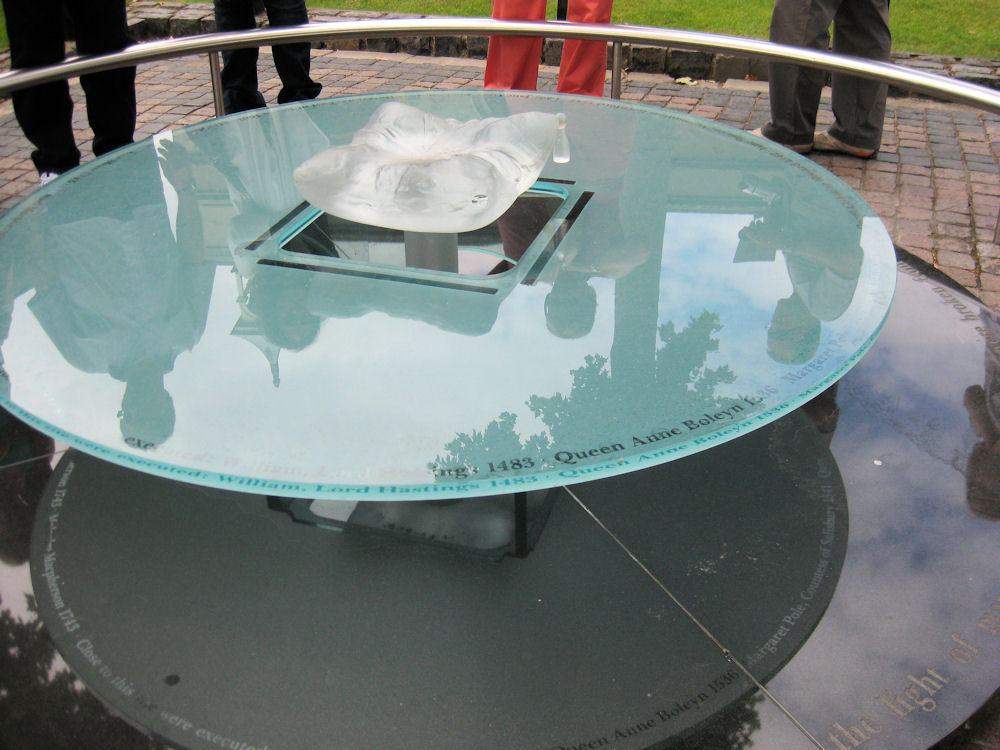
'Gentle visitor pause awhile : where you stand death cut away the light of many days : here jewelled names were broken from the vivid thread of life : may they rest in peace while we walk the generations around their strife and courage : under their restless skies’ - Inscribed on the memorial
The problem isn’t that we sensationalize history, it’s what we consider understandable to the wider audience. It’s how we draw people in, and keep their attention. I talked about this in Mary Sue v1 and v2, but let me just repeat myself.(I do that, y’know.) Women in fiction have two roles to play. She’s either the perfect sweet girl next door who would never do anything to harm anyone (like have sex). Or a horrible conniving manipulate she-devil who uses every weapon in her arsenal (like sex) to hurt and destroy the world, and further her own agenda.* A woman looking out for her own interests has an agenda, you see. Good women don’t care about themselves! We see those archetypes in fiction, because somebody saw them in reality, but we don’t look too close at the context. We don't think about how somebody saw them in the days when women didn’t speak for themselves, and now that we do speak for ourselves, we can’t, because those archetypes are still there, and nobody’s listening to us, and seriously, how’s that for accessible context? Again, I've never seen The Tudors. For all I know, my cousin's comment was less about what went on in the show, and more about her own reaction to it. But, as I said before, nothing goes into a story without a reason, so I have doubts.
Of course, life imitates art imitates life. We are taught to believe the power we have to withhold or wield is sex, we believe that women, other women, who have power we don’t have, or use power we have and don’t use, are evil. We believe it because everybody says it’s true, because it’s right there, all through history, it’s true. We can understand it, because it has to be true, because everybody knows that it is. (And my professors thought I never paid attention in Critical Thinking!)
History’s written by the winners. But I’ll tell you something, if I’m on a losing team, I am going to lose with a thousand people cheering and promising, we’re gonna get ‘em next time!**
*seriously, why is sex evil? I mean, I’m a card-carrying asexual, but I gotta say, sexuals can be such prudes!
** In other words, I was born a Maple Leaf fan, I'll die a Maple Leaf fan.
As we know, this summer, I went on a Fantastic European Tour of Awesome. And among many firsts (first time traveling outside the UK, first time I didn’t fly direct home to Canada, first time in France, first time in Italy, first time sleeping on a train…), it was the first time I travelled with someone other than myself. I took a group tour with a really cool group called Contiki, which specializes in tours for the 18-35 age group. I really do need to check how accessible it is, because all anyone ever tells me is it’s hell flying when you have mobility issues, but I’m independently mobile, and travelled with my cousin, who also walks with some difficulty, and they didn’t even check for the handicap sign when we asked them to let us on the plane early, so we seemed to have dodged any major issues. Also, a surprising number of the places we visited were accessible, though I will say this does not include the hotel room in London, in which the elevator was so tiny that three people had difficulty getting in it at the same time. But if you can go, I would highly recommend it because, in the first place, Europe is awesome, and in the second place, they’re something like $300 a day for the trip, plus your airfare and insurance. Seriously, airfare is ridiculous.
Anyway, that’s just a heads up. What I wanted to talk about was that this was the first time I wasn’t travelling by myself, because in addition to being in a group, I was in the group with my cousin, who is just a couple years younger than I am. It was her first time away from home, and for the most part, it was pretty awesome (leaving aside the absolute weird of being home and having people calling me by my first name, which only my family and my job ever use, which was creepy and unsettling). My cousin and I have a lot in common. She desperately wanted to visit the statue of The Boy in Kensington Gardens, and we both had an amazing time at the Colosseum in Rome, and did lots of shopping. She is excellent with maps, I am okay with getting lost, so all in all, we were great travel companions. However, I don’t say this to sound snobby, but my cousin is not particularly cultured. So every once in a while, stuff like this happened:
“Hey! Let’s go to the Tower of London! It’s amazing, and you’ll see the scaffold where Anne Boleyn lost her head!”
“Wow! That’s awesome. Anne Boleyn was such a whore!”
“…uh. What?”
“Sorry. I’ve seen every episode of The Tudors.”
Full disclosure: I have never seen The Tudors. It’s one of those shows where I always wanted to see it, and I never quite got around to it. Like True Blood, and Glee. I know. I hate myself too. Only now, I’m really glad I haven’t, because that’s possibly the stupidest statement I’ve ever heard anyone make about Anne Boleyn. And yes, I am well aware she had a handful and a half of lovers, and she may have been in love with her brother, and yes, I do know that if a woman in the 21st century had seven lovers and a husband and was in love with her brother, we might call her all sorts of names, and possibly have her institutionalized for the brother thing, so yeah, maybe locking her up in the Tower makes some kind of sense. And that would be wrong, of course, but the major issue here is um, Anne Boleyn didn’t live in the 21st century. She lived in a time where a woman was called a whore for oh… liking sex. She also lived in a time where she was sold to a man who could not have sons. And how did he deal with not having sons? By killing any woman he couldn’t get pregnant. Might make a woman a little desperate to have a son, wouldn’t it?
I’m not here to talk about Anne Boleyn; there are many, many people far more educated than I am who will, if you want to learn. I’m not even going to talk about the crime of rampant historical inaccuracy present in any and all historical retellings of virtually any story with something resembling a real history. That would be the sort of redundant that borders on the ridiculous. What I want to talk about is this mistaken idea that in order to make history interesting or tangible, to make it ‘accessible’, we have to ‘modernize’ it. So let’s talk about modernizing, shall we? Writing the story of the Tudors for television, if we try to make people understand the cultural implications of the day, the struggle for power, which for men, meant wealth, property, and control of human life, and for women meant doing as you’re told, doing it well, and being sold to a powerful enough man that raping or killing you might not be in someone’s best interest. That might be too much to handle. If, however, the little whore deserved it? Oh, well, now it makes sense. If she was power-mad and would stop at nothing, including, the horrors, using her presence as a hot bod to manipulate people into getting what she wanted? If she was an ungrateful little snot with too much money and too little time on her hands? Oh my God! Those Tudors were just like us! Because don’t we all know women like that!
'Gentle visitor pause awhile : where you stand death cut away the light of many days : here jewelled names were broken from the vivid thread of life : may they rest in peace while we walk the generations around their strife and courage : under their restless skies’ - Inscribed on the memorial
The problem isn’t that we sensationalize history, it’s what we consider understandable to the wider audience. It’s how we draw people in, and keep their attention. I talked about this in Mary Sue v1 and v2, but let me just repeat myself.(I do that, y’know.) Women in fiction have two roles to play. She’s either the perfect sweet girl next door who would never do anything to harm anyone (like have sex). Or a horrible conniving manipulate she-devil who uses every weapon in her arsenal (like sex) to hurt and destroy the world, and further her own agenda.* A woman looking out for her own interests has an agenda, you see. Good women don’t care about themselves! We see those archetypes in fiction, because somebody saw them in reality, but we don’t look too close at the context. We don't think about how somebody saw them in the days when women didn’t speak for themselves, and now that we do speak for ourselves, we can’t, because those archetypes are still there, and nobody’s listening to us, and seriously, how’s that for accessible context? Again, I've never seen The Tudors. For all I know, my cousin's comment was less about what went on in the show, and more about her own reaction to it. But, as I said before, nothing goes into a story without a reason, so I have doubts.
Of course, life imitates art imitates life. We are taught to believe the power we have to withhold or wield is sex, we believe that women, other women, who have power we don’t have, or use power we have and don’t use, are evil. We believe it because everybody says it’s true, because it’s right there, all through history, it’s true. We can understand it, because it has to be true, because everybody knows that it is. (And my professors thought I never paid attention in Critical Thinking!)
History’s written by the winners. But I’ll tell you something, if I’m on a losing team, I am going to lose with a thousand people cheering and promising, we’re gonna get ‘em next time!**
*seriously, why is sex evil? I mean, I’m a card-carrying asexual, but I gotta say, sexuals can be such prudes!
** In other words, I was born a Maple Leaf fan, I'll die a Maple Leaf fan.
Monday, May 24, 2010
Something More About Mary (Alternatively: The Damn Twilight Post)
Wow, it's been a while. Hannah's going really good, so I haven't had a second to turn away from it. I scrapped the fifty or so pages I had, and restarted, I'm already further along than I was when I restarted, so, yeah, busy. Also, I've taken to writing a couple posts at once, because there has been a lot going on with everybody these days, on a lot of different fronts, and it helps to cycle through and figure out what goes where and how to make everything fit together. Anyway, sorry for the huge delay, and thanks for another great month! Onward!
The Mary Sue post has apparently gotten me a lot of attention. Colour me surprised. Apparently I have excellent timing, since there's a lot of talk going on. That is awesome, because when I reached the "Mary Sue is bull" epiphany, I got a great big, "WTF" from even the most feminist of readers. There's been some really good discussion about Mary Sue, about why it is sexist, and why it isn't sexist, why it is useless bullying, and why it isn't. There's also been a whole lot of noise, and a whole lot of excuses for bad behavior, fem-hating, and why we need to be able to call out Mary Sue. And there have been some good constructive criticism on my post, and some really pointless noise on my post too. I'm not the kind of person to keep rehashing old arguments, but Twilight turns up a hell of a lot in these conversations. I assume because it's badly written, so very hard to defend. I feel like there's some confusion about my earlier post. And I'm being hassled by certain readers (I'm glaring, so you know) to write about it again. So. You will remember the post where I said I have issues with Twilight I'd rather not discuss? And of course, I mentioned in the Mary Sue post that I had issues with Twilight, but was going to stick to just talking about Mary-Sueisms, and not picking on Twilight? Well.
The time has come to pick on Twilight. And I didn't want to have to write this, not because of Twilight's popularity, or because I would have to admit that I read the entire series, mainly as background reading while planning The Damn Vampire Novel. Or even because I feel a bit petulant about this whole thing, and I don't like being petulant. I didn't want to write it because I am sick and tired of hardcore haters. No really, I am sick and tired of hardcore haters defending their hatred more than I'm sick and tired of hardcore fans defending their love. Admitting your disappointment in Twilight is opening the floodgates to a whole lot of fem-hate and a whole lot of "all ________ are _______" talk, and, while I am about to tear holes all through Twilight, there are some things I just don't want to hear anymore because it takes away from what is actually wrong with the series. And I believe I mentioned, I am a fan of constructive discussion.
A list, then, of things I am not blaming on Twilight.
1. Bella really is a Mary Sue. Yeah. I know. I don't care. Read if you need clarification on this point, and let me just say, Bella is not the problem. Okay? I will be clarifying that later.
2. Rob Pattinson is not that good looking. And hadn't even read the books before getting that role, so where you think he has anything to do with them I will never understand. He's also mentioned his own so-so appearance several times. Which is pretty much enough to make me like him, at least a little bit.
3. Teenage girls only read those books because "omg edward is so hot!!!!"/ Teenage girls are idiots and I'm tired of listening to them go on and on about Team Edward vs Team Jacob - Wow, ageism and sexism all wrapped up in a neat little package. Do I really need to tell you what's wrong with this one?
4. Bella is not good looking enough to get the attention that she gets. Again, I'll be going over this later, but seriously, what? Are you saying Kirsten Stewart, the actress who plays Bella in a series that was written before she was cast to play in it, hi, isn't good looking enough, or are you saying that because Meyer didn't spend pages and pages extolling on her beauty like she did with Edward, Bella can't possibly be that good looking? Or maybe you're just saying, "only Sues have more than one boy, and we hate them so nyeh."
5. Bella's parents don't punish her enough - Okay, that's not a character flaw. Meyer is not a good writer but, alternatively, Bella's parents are idiots. They married too young and have no responsibility for themselves, let alone their offspring. That's pretty established, whether because Meyer actually happened to put some thought into that one, or because it mirrors her own experiences. It happens in real life too. Look it up. Also, please remember, JKR has admitted the reason HP takes place at a boarding school is the lack of adult interference. Clearly, Meyer didn't have that out, and couldn't think of a better one. Which brings us back to yes, okay, the books are badly written!
6. I could write better than that/Meyer's not a real writer - Neither am I. Neither were a lot of first timers. Just because they did better than she did, doesn't make her any less real, nor any less a writer. I know, I'm mad this slipped through the slush pile too, but seriously? There's a lot we can hold her responsible for, but it's not her fault they published the damn thing, and this happened. Somebody, somewhere should have stopped her, and nobody did.
7. I have nothing against Twilight, I'm just tired of seeing it everywhere. Oh whine whine whine. This usually comes from one of those people who likes things that are unpopular on purpose. Liking something because it's unpopular, or trashing it because it's popular, is pretty much the same as liking something because it's popular. You're still being a disingenuous ass, you just get to do so with a smattering of hipster cred. Congrats. You hang on to that.
8. Meyer has ruined vampires forever - Uh. no. Meyer's publishers have ruined vampires for the moment. Because now they've let that through, publishing companies are hungry for more sparkly vampire stories, and Meyer is, for the moment at least, done. (You are free to cheer, I won't hold it against you.) And by the way, vampires have been going the way of the unicorn since Anne Rice. Get over it, or do like you keep insinuating you can, and write something better.
9. They sparkle. That's pathetic - Okay, from a practical standpoint, Meyer was just dealing with a plot hole. It was a stupid way to deal with a plot hole, but compared to the rest of the stupidity, it was positively brilliant, in that she actually went, "hmm, I'm going to have to deal with the whole, 'vampires burn up in the sun' thing." And then, y'know. Dealt with it. Stupidly, yes, but it still counts as a tiny inkling of foresight in the direction of people might not buy this. Also, before anyone brings it up, I get that stupid sparkly vampires is just shorthand for badly written vampire novel. Uh-huh. And you know what? Mary Sue is just shorthand for badly written female character by a female author. Only stupid sparkly vampires has morphed to mean Vampire book marketed at teenage girls, which is probably inherently bad due to subject matter and intended audience. Much in the same way that Mary Sue has morphed to mean there's a girl in that fic that someone just made up! Get her out! That's pathetic and obviously about you because only sexually frustrated hetero teenage girls write fanfic!
There. If any of your complaints sound anything like that, you are as free to make them as I am to delete them from my comments because that is so not the point. Yes, I admit, I am also frustrated that the quality of adult or YA fairytales has gone down in a hurry, as I have previously mentioned. Which is why I am writing my own, and will publish it independently, since publishers seem intent on pushing this crap at us. I'm not defending it. I know it's badly written. I know it sucks. I know you're sick of it. I'm sick of it. What I am saying is the books have zero plot, and a whole lot of creepy sexist BS, and a huge following of kids who now believe the creepy sexist BS, and we ignore that because it's easier to just pick on Bella Swan. This is why Mary Sue is dangerous.
For people who still don't see Mary Sue as a misogynist tactic, let me lay it down for you. First off, you are wrong. I don't know how much clearer I can make it than to say we have a word designed to make girls who dare to believe that they are, or can be, smart, attractive, successful and impressive, feel immature and ridiculous. But I am damn sure going to try, because this is not ridiculous, it is not frivolous, it is important, and affects how women and girls view themselves and their experiences, as artists and as women, and it also affects how the artistic community views women. So here we go again.
What is wrong with Twilight, and why "Bella is a Mary Sue" is just adding to the problem.
Consider that even hardcore Twilight haters have almost nothing to say about Edward. Many times, Edward does not factor in at all. There's been talk about Edward being creepy and way beyond 'bad boy.' But it gets buried a lot of times in the "Bella's not that pretty. Why does everybody like her?" noise. So, let's just clarify. A bloodsucking monster who admits he has no soul, and every time he kisses his girlfriend, he has to fight the urge to kill her, gets more sympathy from readers than a teenage girl with low self-esteem who is used to not living up to the standards of beauty, and possibly doesn't understand that she's as appealing as she is? And what about Jacob? The perfect sweetest best friend in the world who has made it known to Bella that he's not okay with just being a friend, and is, in fact, only biding his time until she comes to her senses... Or has a child, who he can fall hopelessly in love with, and patiently wait til she is an acceptable age to have? (Which is made easier by the fact that she ages really really fast.) Because in his tribe, that's what you do. You wear women down with your affection! (There's probably some racial appropriation in there too, come to that. The whole thing gives me squickies, but like I said, I don't like to dissect marginalized groups that I'm not part of. Someone want to take over that side of the discussion for me?) He gets no mentions whatsoever, and we have Bella, who can't decide whether to fall for the Nice Guy routine, or get the bad boy because she makes him a better person, which by the way, is the same tired plot line played out on highly rated TV shows all the time. This one bad character in a sea of bad character cliches gets canonized, called names. Well gee, where do you think that comes from? Not girl-hate, surely. Not sexism.
I want you to do something for me, before we start arguing. (Oh noes! More homework!) For just a second, replace the word Mary Sue, with the word "slut." I know, for all intents and purposes, it doesn't actually mean the same, but, humor me. So now, if in your head you're thinking, "Bella is a Mary Sue," you are now thinking, "Bella is a slut." If in your head, you're thinking, "But some characters are Mary Sues. It's okay to hate them." You are now thinking, "But some characters are sluts, it's okay to hate them!" If you're thinking, "Meyer writes Mary Sues and gets published, and that makes her a bad writer, because now everybody thinks they can write a Mary Sue and Mary Sue is bad!", you are now thinking... Well, you get the idea. It's not that I believe Mary Sue is synonymous with slut, or even that I believe that a lot of people do, (though you can see the corollary, can't you, between Bella Swan getting 'unwarranted' male attention, and how much people dislike her for it?) What I'm saying is, like with the word 'slut' we assume everybody knows what Mary Sue means, and that it means the same to everyone.
When you call someone a slut, you're saying, "you are having lots and lots and lots (and lots) of really, really, really inappropriate sex. I am not, therefore, I have a right to disapprove of you. You make my sex less meaningful and important." Except for the times you're just saying, "I don't like you. I don't like what you do or how you do it, or who you are, or that you don't hate you as much as I do. You need to hate yourself in order to make up for how awful you really are." Using that word means you get to make assumptions of how much and what kind of sex is bad. How those people dress, how they act, how they might redeem themselves, and why they need to. You make assumptions that either they are fundamentally broken, or they are just selfish and stupid and nobody needed to break them to make them into the horrible people they are. Most importantly, though, you make the assumption that healthy, normal people agree with you, that everybody knows, instinctively, how much sex is bad, that there are bad reasons for sex, and what those reasons are, and how to present yourself as the kind of person who is a slut, or the kind of person who is not. When you use that word, you claim your own rules as finite, and are free to assume, then, that everyone breaking them is doing so with full knowledge of the rules. Which makes them bad people. You forget that there is no way to tell the difference between the 'slut' you disapprove of based on her actually doing things you just don't like (which really isn't your damn business, but that's just a niggly little detail, isn't it?) or the 'slut' you just dislike, as a general rule. That doesn't matter, they need to fix their behavior to your standards, or at the very least, be appropriately shamed.
Allow me to perform a little translation: When you accuse someone of writing a Mary Sue, you subscribe to similar universalities. You assume that everyone feels the way about Mary Sue that you do, that is, a Mary Sue is universally bad, and everybody agrees with you as to what way and by what degree of bad it is. There are certainly things that all Mary Sues have in common, ie, they're all women or girls, they're written by women or girls, they're not well-written, and the assumption is, they are completely unnecessary and totally unrealistic. But the good ol' Mary Sue Litmus Test, in trying to rid the world of the horrors of unrealistically cool and unique female characters, has proven that it is pretty much impossible for Mary Sue to be a universal anything. Therefore, we should play it safe and avoid anything that makes our girls and women interesting, unique, memorable, strong, independent, and, in fact, necessary to the story. You forget that sometimes, Mary Sue doesn't mean 'badly written', and the only real, solid, all-across-the-board trait of a 'Mary-Sue' is that she is female, and so is her author. Sometimes, that's enough, in both original and fanfic, to make her unnecessary, to some readers. Why write a woman if you don't have to? What kind of person would do that? (A bad, bad person.) Which is sort of like what happens in real life, to girls and women everywhere. Except we're allowed to do it when discussing fiction, because those girls aren't real, and nobody's feelings get hurt, and we have to be allowed to hate them somewhere, in some abstract way, right? Except fem-hate is not abstract. It affects a lot of people in very real ways, from the amount of opportunities an actress is afforded, if she's willing to do a nude scene, and the backlash she deals with after the fact, to the amount of books sold by a YA author who dares use a female protagonist without having a boy in there for potential readers to 'identify' with, to the recent climb in the popularity of unisex baby names, as parents decide they want people to not judge their children by the name provided on a job or loan application. I'm not going to tell you what fandoms I hail from myself, (that would be overshare) but if I read one more RPF disclaimer that uses a real-life gf as an antagonist, (I really really like her, honest. *eyeroll*) or one more slash reader who apologizes for writing a heterosexual scene, I am going to go absolutely bats.
And yes, I did actually read that cute little disclaimer on the bottom, where it promises that sometimes, some things, you can get away with, maybe. I also noticed they were a lot less thorough on when, how, or why, it was okay to 'break the rules' than on when it wasn't. Or the clear tone of, "Okay, yeah, this happens, but you're probably a novice because talented people wouldn't write fan fiction at all, would they? And talented people wouldn't put their original fiction on the Internet, because they would be able to get paid for what they do, wouldn't they? So you should stick to the rules, you n00b." (-Side note, there's a post coming about why talented people might write fanfic, blogs, and online fiction, rather than risk the publishing process.)
Face it. Your fandom is not girl- or woman-friendly. My fandom is not girl- or woman-friendly. It is assumed that fandom is composed mainly of heterosexual young girls and young women, therefore, sexism goes unchecked. But, from the assumption that we're all teenage girls (and the ageism and sexism that go along with that), that we are only in it for the pretty, that the writers who write, say, slash, should be taken more seriously, given more cred, than the ones who write about icky girls, to the prevalence, even among slash writers, to lean towards relationship roles and portrayals that are staunchly heteronormative and incredibly sexist (genderswap* fics where a male character magically grows long hair over night, as if that is just as clear a marker of femininity as breasts and a vagina**, slash pairings where it's practically canon that one character takes on the 'feminine' roles and traits and the other the more 'masculine' with annoying consistency.) ...You know the fem-hate is there, and you know, in some small part, you subscribe to it. Even I'm guilty of rolling my eyes and thinking 'teenage girl' if something's spelled poorly, or if it's poorly written. Despite the fact that, as I have mentioned, at twenty-five, and with quite a few years of practice, I can't spell. Even I'm shocked to find a straight boy who writes fan fiction, despite the fact that I stumbled upon some of my nearest and dearest, both male and female, and every sexuality in the spectrum, in that way. I'm learning, and improving. I'm trying.
Back to Twilight, then. Twilight is very obviously very poorly written. I won't go as far as to say it has no plot, because if Meyer had stuck to one novel, and done that whole star-crossed lovers thing, and let it go, probably, I would be complaining much less than I am. I do know even the first novel was problematic. I'll get to that. I know Twilight reads like a Harlequin, but I'm not going to complain about that again, because you know what? A hell of a lot of Harlequin women have PhDs. That means they are not the stereotype of bored housewife you may see them as, nor are they necessarily bad writers. And there's nothing wrong with healthy escapism. That is not my kind of escapism, but really? Who am I to judge? I'm asexual, can you imagine what would happen if I tried to impose the goals I set for myself on other people? That would be utterly ridiculous.
What happened was Meyer didn't have enough plot for the characters and world she created. It happens to me, usually at about 4 in the morning, and 70 pages in I'll realize I like the characters way more than I like writing about them. Difference is, and I don't like to toot my own horn, but I usually realize that is the point at which we put the work down. (Usually. Not always. Oh, Jack.) Meyer didn't. In fact, she kept going for four whole books! It must be said, truthfully, she turns a pretty phrase. People will be using those books to create IM handles, MSN names, and Cafe Press products for at least the next five years. But her concept of plot progression and character growth is virtually nonexistent. Her characters are wooden and they are predictable and they are cliche, and they don't even follow the flimsy rules that she herself has created for the purpose of her own story. I can acknowledge the boldness in my previous statement, that is, Mary Sue is a myth. Because there are badly written female characters, yes. But a Mary Sue is a badly written female character that does not fit into the world she inhabits, and is, therefore, not necessary. Since all of Meyers characters are ridiculous and pathetic, it's really no surprise Bella is similarly two-dimensional. And yes, she is more talented and meant to be more interesting than all the others, and clearly, we are expected to keel over this girl and worship her the same way her author does. So in that sense, I suppose, it counts as Mary Sueism. But ask yourself, honestly, if the story would be that much improved if Bella was slightly more realistic? More than likely, we would look at Bella, amongst all these other flimsy characters, and still yell Mary-Sue, because if Bella was more realistic, she would stand out amongst all of the characters that aren't realistic! I'm not saying Bella Swan is not a problem. Bad writing is still bad writing. I am saying that Bella is not the problem. And the fact that so many people find it easier to shortcut their hatred of Twilight into their hatred of its female protagonist, well, that is the problem. It comes from years of burying female protagonists into this or that type or this or that role, because people will believe those types, those roles. It comes from young writers learning from an early age that girls don't like reading about girls, because all girls are naturally jealous and possessive, and boys need to read about boys, or they'll come out backwards. It comes from sexism. And it lends to the idea that if Bella were just a different kind of girl, or, hey, not a girl at all, the story would be that much better. And it just wouldn't. (Okay, well, honestly, a high school love story featuring gay vampires would be pretty awesome, but I really don't think Meyer could pull that off either, so you understand my point.)
Meyer clearly has issues with man/woman dynamics that I'm not even going to speculate on. I don't date, I have no interest in sex, so I don't know exactly what normal and healthy is. I just know that's not it. I was confused when someone first brought to my attention the inherent sexism within the book, because like I said, Bella cooking for her father because he's an irresponsible mopey asshole doesn't seem that far-fetched to me. Then I read book two. Wherein Bella tries to kill herself because her boyfriend breaks up with her, falls in with the ultimate Nice Guy, and becomes an irresponsible adrenaline junkie who alienates her friends because none of them are worth anything to her. Then she goes off and becomes a vampire, because her mother who she loves and has protected her whole life, now has a man to do that. There's a scene in the fourth book, where Bella marvels, "Maybe I just have no imagination. I couldn't imagine I would enjoy marriage, until I actually was married. I couldn't imagine I would want a child, until I was pregnant." At that point, I literally had to put the book down for several minutes and calm down, because the message was clearly that women need to be forced into a life of domesticated bliss, but once they're there, their women-hormones take over, and everything just turns out peachy, and you know what? If I hear about how I just need to find the right guy one more fucking time, I am just going to start screaming and not stop. That's at least three rage posts right there. And you're probably going to get stuck reading them, at some point.
There's an idea that teenagers are naturally stupid. Science supports this idea, by telling us that it is our ability to be rational that develops last, when puberty sets in. Socialization teaches us that women are helpless, women need guidance, that women want to be helpers, and nurturers, that they have no desire to express any kind of selfishness, up to and including leading our own lives, being responsible for our own sense of self rather than having someone decide what we should be and do, and finding peace and success on our own. Socialization is wrong, and scientific study is imperfect, and it doesn't matter. These two things band together to form the idea that teenage girls are stupid and simple, and will follow every whim that they get in their flighty little imperfect girl-heads. And because girls are emotional, a girl's feelings should be held in even less account than an adult woman's, because science says that teenagers can't be rational, and of course, feelings is a girl thing, ergo, a girl's feelings are irrational, and not worth anything, and not real, and she must be trained to understand the difference between herself and real people, and live within those boundaries, and be an adorable little stupid, until such time where she is required to be an adult, and thus, give all her time and attention to everyone besides herself. If she dares to be involved in her life for her own sake, she is selfish, and immature. So the self-indulgence of writing in a way that validates her existence, experience, and feelings, is obviously a mark of stupidity and immaturity. She must be mocked, until she grows up, and agrees to spend her life making others happy.
Some of you will remind me at this point, that a lot of things written for or by teenage girls are ridiculous. And there are a lot of ridiculous teenage girls. And you're right. But there is a machine at work here. I talked, before, about how part of ablism is convincing us to subscribe to the ideas that we are here to educate others about disability, inspire others to greatness or kindness, or teach others to value themselves more, by reminding them they are not yet as bad as they can be (because we are). They do this by making those roles the only ones we are ever visible in. If one of us should happen to break out of those roles, the people running the machine can use that to pat themselves on the back, to remind us, you, and themselves, that the machine is working. And we are the proof. So there are scores of people with disabilities who believe that they are not meant for anything special, they really do want to be treated like everyone else (because really, who'd want to be them, if they could be anyone else?), and that if someone is an ablist asshole, it really is because they don't know any better, and we really don't have anything better to do than teach. The same principle is at work here. Teenage girls are taught what they're supposed to have, what they're supposed to expect, what they're supposed to want, and how ridiculously important stupid vapid things are supposed to be. How they're not supposed to focus on 'real' things, and they're supposed to accept and understand that the things they do like, want, or find value in, are then, stupid and unimportant, by virtue of their nature. And that's okay! They can't help it! Science says we're not meant to be smart or important.
So, we learn to not trust how we feel about things, we learn to be easily manipulated and easily fooled, and learn how easily not being manipulated and fooled can pick you off from the herd and make you *gulp* Unlikeable. Likeable is what people want, but most especially a girl, who, in order to continually to be comfortable in her own skin, would have to find people to take responsibility for her, since it is Bad to do that for herself. When we see the same goddamn thing over and over, eventually, at some point, some reach the mistaken conclusion, "yeah, okay, it can't suck that bad, if it's everywhere." Because it is the only real option we have. Then stuff like this becomes popular, as it is meant to, and people go, "God, if teenage girls weren't so stupid we wouldn't have to put up with this!" Teenage girls are not stupid. Teenage girls are people who are treated a certain way based on their age, sex, and importance in society. Same as everybody else, but different, simply because, as a society, we decide that teenagers, particularly teenage girls have no real value, and their hierarchy is separate from the real world, since they only matter amongst each other. We pass that knowledge on to them, and they use it, even within their own safe space. Thus, we get things like Mary Sue, created to keep girls and women in a certain space and mind. We get jealousy, hatred and distrust of all things girl and woman. Of all things that suggest a power, strength, and originality, we are not supposed to have. That will not get us where we apparently want to be.
There are a lot of things wrong with Twilight. It glorifies a coercive relationship that is very clearly not between equals by a long shot. It underlines the idea that the formation of a young woman's identity lies not with her independence, or her decisions about her future, and how she copes with those responsibilities, but with, more specifically, her choices about boys and men, who she chooses to be with, and why, and how she handles herself while in a relationship, out of a relationship, or even looking for a relationship. The idea that she might not be looking for a relationship is seldom acknowledged, except as a character flaw or reaction to male influence. Incidentally, this happens both in fiction, and in real life. (Trust me, I know.)
One of the characters I actually liked in the series was Leah Clearwater, the lone she-wolf in Jacob's pack. She talks about her confusion as to why she is the only woman in the pack, her pain at being spurned by the man she loves, and having to acknowledge that he loves this other woman more than her, while forced to remain in her family unit, a constant witness to the betrayal, and constantly ostracized simply because she is female, and shouldn't be there. She talks openly about fear of infertility and being unlovable, but still has the strength to stand up to the (literal) alpha males in her life. I have to wonder if Meyer was trying to make some point about sexuality and certain kinds of girls, and their ability and right to attract mates, and to expect male affection. I don't like thinking it, but with everything else wrong with the series, it wouldn't surprise me.
The books describe sex as something where it's forgiven and expected that it will hurt, something that can be dangerous to your health and life, and something in which the rights to decisions should be given to the man. It describes marriage and babies as a forgone conclusion, and parents and friends as necessary only in the absence of your real connection, that is, with a man. It is repulsively racist towards people of First Nation descent, and casually talks about grooming young children for marriage, and the fact that all women are helpless in the face of any and all male affection. It makes stalking look romantic, cool detachment look heroic, and non-consensual acts, such as Jacob kissing Bella when she clearly doesn't want him to and has no real way to fight him off, look forgivable. The fact that this is being fed, with mass success, to a group of people trained to believe it's better to want what people tell you to want, is, yes, frightening. The fact that it is badly written, is, I can admit, insulting.
I probably forgot a whole lot of things that are wrong with the series, but the one thing I do know is this: Bella Swan is a badly written character in a series of badly written novels. That Meyer wrote a character that so embodies her own sexist ideology is certainly revolting, but hardly surprising. My distaste has more to do with the ideology than with who or what Meyer modeled her after. That Bella is used as a short-hand for everything that is wrong with those books, is, in itself, sexist. That we hate her because we can, because it makes sense that we would, is sexist. That we hate her because she appeals to teenage girls is sexist. That we hate her because we know she is modeled after Meyer is also sexist. With all the problems, that Bella is a Mary Sue is the most easily understood complaint, is simply a product of how natural, understandable, and forgivable, hatred, distrust, and disbelief of women and girls in the world of fiction really is. Which translates, with horrible ease, to how naturally understandable and forgivable it is to hate, distrust, and disbelieve women and girls outside of fiction, even, and sometimes especially, among other girls and women. It is a mark of sexism, however you excuse it.
And if you still don't understand that, I urge you to reexamine your prejudices, because you are, in all likelihood, sexist. I don't want to hear how Bella Swan is proof that you have the reasons and the right to hate female characters because they are probably 'Mary Sue'. That both the badly written character and the questionably talented author are female is not the problem. Meyer, as a woman, has every damn right to write a girl character, to the best of her ability, if she chooses to do so. Yes, even if her abilities are on the 'yikes' side of questionable. Writing a woman or girl because you are a woman or girl is not some kind of weakness. It does not, on its own, denote a lack of originality. We have the right to find value in our own experiences. Even if we're absolutely useless at expressing them in the medium we'd like, or those experiences are really very harmful, and lead to some serious backward thinking. Like you, Twilight haters, I don't feel Meyer's creation deserves the attention it gets. I wish young girls and young women were not exposed to this backward thinking. I believe it is dangerous and harmful. But unlike you, I will not be part of it. You cannot fight sexism with sexism. Bad writing, and the use of cliche, is not a girl thing.
*Genderswap fics, if we are to be accurate, should really be labeled sex-swap fics, as my dear love so kindly pointed out to me. Sex and gender are not the same thing.
**There are other female body parts, btw. Just a note. There are many parts to the vulva.
AN: I don't mean to disappear anyone who isn't a young girl or woman in fandom. I just wanted to address the fact that being a girl or a young woman is not deserving of the scorn it tends to generate. If anyone has another perspective on the sexism in zir fandom, I would love to hear it.
AN2: To Riley and Claire: I went there. Are we happy now?
The Mary Sue post has apparently gotten me a lot of attention. Colour me surprised. Apparently I have excellent timing, since there's a lot of talk going on. That is awesome, because when I reached the "Mary Sue is bull" epiphany, I got a great big, "WTF" from even the most feminist of readers. There's been some really good discussion about Mary Sue, about why it is sexist, and why it isn't sexist, why it is useless bullying, and why it isn't. There's also been a whole lot of noise, and a whole lot of excuses for bad behavior, fem-hating, and why we need to be able to call out Mary Sue. And there have been some good constructive criticism on my post, and some really pointless noise on my post too. I'm not the kind of person to keep rehashing old arguments, but Twilight turns up a hell of a lot in these conversations. I assume because it's badly written, so very hard to defend. I feel like there's some confusion about my earlier post. And I'm being hassled by certain readers (I'm glaring, so you know) to write about it again. So. You will remember the post where I said I have issues with Twilight I'd rather not discuss? And of course, I mentioned in the Mary Sue post that I had issues with Twilight, but was going to stick to just talking about Mary-Sueisms, and not picking on Twilight? Well.
The time has come to pick on Twilight. And I didn't want to have to write this, not because of Twilight's popularity, or because I would have to admit that I read the entire series, mainly as background reading while planning The Damn Vampire Novel. Or even because I feel a bit petulant about this whole thing, and I don't like being petulant. I didn't want to write it because I am sick and tired of hardcore haters. No really, I am sick and tired of hardcore haters defending their hatred more than I'm sick and tired of hardcore fans defending their love. Admitting your disappointment in Twilight is opening the floodgates to a whole lot of fem-hate and a whole lot of "all ________ are _______" talk, and, while I am about to tear holes all through Twilight, there are some things I just don't want to hear anymore because it takes away from what is actually wrong with the series. And I believe I mentioned, I am a fan of constructive discussion.
A list, then, of things I am not blaming on Twilight.
1. Bella really is a Mary Sue. Yeah. I know. I don't care. Read if you need clarification on this point, and let me just say, Bella is not the problem. Okay? I will be clarifying that later.
2. Rob Pattinson is not that good looking. And hadn't even read the books before getting that role, so where you think he has anything to do with them I will never understand. He's also mentioned his own so-so appearance several times. Which is pretty much enough to make me like him, at least a little bit.
3. Teenage girls only read those books because "omg edward is so hot!!!!"/ Teenage girls are idiots and I'm tired of listening to them go on and on about Team Edward vs Team Jacob - Wow, ageism and sexism all wrapped up in a neat little package. Do I really need to tell you what's wrong with this one?
4. Bella is not good looking enough to get the attention that she gets. Again, I'll be going over this later, but seriously, what? Are you saying Kirsten Stewart, the actress who plays Bella in a series that was written before she was cast to play in it, hi, isn't good looking enough, or are you saying that because Meyer didn't spend pages and pages extolling on her beauty like she did with Edward, Bella can't possibly be that good looking? Or maybe you're just saying, "only Sues have more than one boy, and we hate them so nyeh."
5. Bella's parents don't punish her enough - Okay, that's not a character flaw. Meyer is not a good writer but, alternatively, Bella's parents are idiots. They married too young and have no responsibility for themselves, let alone their offspring. That's pretty established, whether because Meyer actually happened to put some thought into that one, or because it mirrors her own experiences. It happens in real life too. Look it up. Also, please remember, JKR has admitted the reason HP takes place at a boarding school is the lack of adult interference. Clearly, Meyer didn't have that out, and couldn't think of a better one. Which brings us back to yes, okay, the books are badly written!
6. I could write better than that/Meyer's not a real writer - Neither am I. Neither were a lot of first timers. Just because they did better than she did, doesn't make her any less real, nor any less a writer. I know, I'm mad this slipped through the slush pile too, but seriously? There's a lot we can hold her responsible for, but it's not her fault they published the damn thing, and this happened. Somebody, somewhere should have stopped her, and nobody did.
7. I have nothing against Twilight, I'm just tired of seeing it everywhere. Oh whine whine whine. This usually comes from one of those people who likes things that are unpopular on purpose. Liking something because it's unpopular, or trashing it because it's popular, is pretty much the same as liking something because it's popular. You're still being a disingenuous ass, you just get to do so with a smattering of hipster cred. Congrats. You hang on to that.
8. Meyer has ruined vampires forever - Uh. no. Meyer's publishers have ruined vampires for the moment. Because now they've let that through, publishing companies are hungry for more sparkly vampire stories, and Meyer is, for the moment at least, done. (You are free to cheer, I won't hold it against you.) And by the way, vampires have been going the way of the unicorn since Anne Rice. Get over it, or do like you keep insinuating you can, and write something better.
9. They sparkle. That's pathetic - Okay, from a practical standpoint, Meyer was just dealing with a plot hole. It was a stupid way to deal with a plot hole, but compared to the rest of the stupidity, it was positively brilliant, in that she actually went, "hmm, I'm going to have to deal with the whole, 'vampires burn up in the sun' thing." And then, y'know. Dealt with it. Stupidly, yes, but it still counts as a tiny inkling of foresight in the direction of people might not buy this. Also, before anyone brings it up, I get that stupid sparkly vampires is just shorthand for badly written vampire novel. Uh-huh. And you know what? Mary Sue is just shorthand for badly written female character by a female author. Only stupid sparkly vampires has morphed to mean Vampire book marketed at teenage girls, which is probably inherently bad due to subject matter and intended audience. Much in the same way that Mary Sue has morphed to mean there's a girl in that fic that someone just made up! Get her out! That's pathetic and obviously about you because only sexually frustrated hetero teenage girls write fanfic!
There. If any of your complaints sound anything like that, you are as free to make them as I am to delete them from my comments because that is so not the point. Yes, I admit, I am also frustrated that the quality of adult or YA fairytales has gone down in a hurry, as I have previously mentioned. Which is why I am writing my own, and will publish it independently, since publishers seem intent on pushing this crap at us. I'm not defending it. I know it's badly written. I know it sucks. I know you're sick of it. I'm sick of it. What I am saying is the books have zero plot, and a whole lot of creepy sexist BS, and a huge following of kids who now believe the creepy sexist BS, and we ignore that because it's easier to just pick on Bella Swan. This is why Mary Sue is dangerous.
For people who still don't see Mary Sue as a misogynist tactic, let me lay it down for you. First off, you are wrong. I don't know how much clearer I can make it than to say we have a word designed to make girls who dare to believe that they are, or can be, smart, attractive, successful and impressive, feel immature and ridiculous. But I am damn sure going to try, because this is not ridiculous, it is not frivolous, it is important, and affects how women and girls view themselves and their experiences, as artists and as women, and it also affects how the artistic community views women. So here we go again.
What is wrong with Twilight, and why "Bella is a Mary Sue" is just adding to the problem.
Consider that even hardcore Twilight haters have almost nothing to say about Edward. Many times, Edward does not factor in at all. There's been talk about Edward being creepy and way beyond 'bad boy.' But it gets buried a lot of times in the "Bella's not that pretty. Why does everybody like her?" noise. So, let's just clarify. A bloodsucking monster who admits he has no soul, and every time he kisses his girlfriend, he has to fight the urge to kill her, gets more sympathy from readers than a teenage girl with low self-esteem who is used to not living up to the standards of beauty, and possibly doesn't understand that she's as appealing as she is? And what about Jacob? The perfect sweetest best friend in the world who has made it known to Bella that he's not okay with just being a friend, and is, in fact, only biding his time until she comes to her senses... Or has a child, who he can fall hopelessly in love with, and patiently wait til she is an acceptable age to have? (Which is made easier by the fact that she ages really really fast.) Because in his tribe, that's what you do. You wear women down with your affection! (There's probably some racial appropriation in there too, come to that. The whole thing gives me squickies, but like I said, I don't like to dissect marginalized groups that I'm not part of. Someone want to take over that side of the discussion for me?) He gets no mentions whatsoever, and we have Bella, who can't decide whether to fall for the Nice Guy routine, or get the bad boy because she makes him a better person, which by the way, is the same tired plot line played out on highly rated TV shows all the time. This one bad character in a sea of bad character cliches gets canonized, called names. Well gee, where do you think that comes from? Not girl-hate, surely. Not sexism.
I want you to do something for me, before we start arguing. (Oh noes! More homework!) For just a second, replace the word Mary Sue, with the word "slut." I know, for all intents and purposes, it doesn't actually mean the same, but, humor me. So now, if in your head you're thinking, "Bella is a Mary Sue," you are now thinking, "Bella is a slut." If in your head, you're thinking, "But some characters are Mary Sues. It's okay to hate them." You are now thinking, "But some characters are sluts, it's okay to hate them!" If you're thinking, "Meyer writes Mary Sues and gets published, and that makes her a bad writer, because now everybody thinks they can write a Mary Sue and Mary Sue is bad!", you are now thinking... Well, you get the idea. It's not that I believe Mary Sue is synonymous with slut, or even that I believe that a lot of people do, (though you can see the corollary, can't you, between Bella Swan getting 'unwarranted' male attention, and how much people dislike her for it?) What I'm saying is, like with the word 'slut' we assume everybody knows what Mary Sue means, and that it means the same to everyone.
When you call someone a slut, you're saying, "you are having lots and lots and lots (and lots) of really, really, really inappropriate sex. I am not, therefore, I have a right to disapprove of you. You make my sex less meaningful and important." Except for the times you're just saying, "I don't like you. I don't like what you do or how you do it, or who you are, or that you don't hate you as much as I do. You need to hate yourself in order to make up for how awful you really are." Using that word means you get to make assumptions of how much and what kind of sex is bad. How those people dress, how they act, how they might redeem themselves, and why they need to. You make assumptions that either they are fundamentally broken, or they are just selfish and stupid and nobody needed to break them to make them into the horrible people they are. Most importantly, though, you make the assumption that healthy, normal people agree with you, that everybody knows, instinctively, how much sex is bad, that there are bad reasons for sex, and what those reasons are, and how to present yourself as the kind of person who is a slut, or the kind of person who is not. When you use that word, you claim your own rules as finite, and are free to assume, then, that everyone breaking them is doing so with full knowledge of the rules. Which makes them bad people. You forget that there is no way to tell the difference between the 'slut' you disapprove of based on her actually doing things you just don't like (which really isn't your damn business, but that's just a niggly little detail, isn't it?) or the 'slut' you just dislike, as a general rule. That doesn't matter, they need to fix their behavior to your standards, or at the very least, be appropriately shamed.
Allow me to perform a little translation: When you accuse someone of writing a Mary Sue, you subscribe to similar universalities. You assume that everyone feels the way about Mary Sue that you do, that is, a Mary Sue is universally bad, and everybody agrees with you as to what way and by what degree of bad it is. There are certainly things that all Mary Sues have in common, ie, they're all women or girls, they're written by women or girls, they're not well-written, and the assumption is, they are completely unnecessary and totally unrealistic. But the good ol' Mary Sue Litmus Test, in trying to rid the world of the horrors of unrealistically cool and unique female characters, has proven that it is pretty much impossible for Mary Sue to be a universal anything. Therefore, we should play it safe and avoid anything that makes our girls and women interesting, unique, memorable, strong, independent, and, in fact, necessary to the story. You forget that sometimes, Mary Sue doesn't mean 'badly written', and the only real, solid, all-across-the-board trait of a 'Mary-Sue' is that she is female, and so is her author. Sometimes, that's enough, in both original and fanfic, to make her unnecessary, to some readers. Why write a woman if you don't have to? What kind of person would do that? (A bad, bad person.) Which is sort of like what happens in real life, to girls and women everywhere. Except we're allowed to do it when discussing fiction, because those girls aren't real, and nobody's feelings get hurt, and we have to be allowed to hate them somewhere, in some abstract way, right? Except fem-hate is not abstract. It affects a lot of people in very real ways, from the amount of opportunities an actress is afforded, if she's willing to do a nude scene, and the backlash she deals with after the fact, to the amount of books sold by a YA author who dares use a female protagonist without having a boy in there for potential readers to 'identify' with, to the recent climb in the popularity of unisex baby names, as parents decide they want people to not judge their children by the name provided on a job or loan application. I'm not going to tell you what fandoms I hail from myself, (that would be overshare) but if I read one more RPF disclaimer that uses a real-life gf as an antagonist, (I really really like her, honest. *eyeroll*) or one more slash reader who apologizes for writing a heterosexual scene, I am going to go absolutely bats.
And yes, I did actually read that cute little disclaimer on the bottom, where it promises that sometimes, some things, you can get away with, maybe. I also noticed they were a lot less thorough on when, how, or why, it was okay to 'break the rules' than on when it wasn't. Or the clear tone of, "Okay, yeah, this happens, but you're probably a novice because talented people wouldn't write fan fiction at all, would they? And talented people wouldn't put their original fiction on the Internet, because they would be able to get paid for what they do, wouldn't they? So you should stick to the rules, you n00b." (-Side note, there's a post coming about why talented people might write fanfic, blogs, and online fiction, rather than risk the publishing process.)
Face it. Your fandom is not girl- or woman-friendly. My fandom is not girl- or woman-friendly. It is assumed that fandom is composed mainly of heterosexual young girls and young women, therefore, sexism goes unchecked. But, from the assumption that we're all teenage girls (and the ageism and sexism that go along with that), that we are only in it for the pretty, that the writers who write, say, slash, should be taken more seriously, given more cred, than the ones who write about icky girls, to the prevalence, even among slash writers, to lean towards relationship roles and portrayals that are staunchly heteronormative and incredibly sexist (genderswap* fics where a male character magically grows long hair over night, as if that is just as clear a marker of femininity as breasts and a vagina**, slash pairings where it's practically canon that one character takes on the 'feminine' roles and traits and the other the more 'masculine' with annoying consistency.) ...You know the fem-hate is there, and you know, in some small part, you subscribe to it. Even I'm guilty of rolling my eyes and thinking 'teenage girl' if something's spelled poorly, or if it's poorly written. Despite the fact that, as I have mentioned, at twenty-five, and with quite a few years of practice, I can't spell. Even I'm shocked to find a straight boy who writes fan fiction, despite the fact that I stumbled upon some of my nearest and dearest, both male and female, and every sexuality in the spectrum, in that way. I'm learning, and improving. I'm trying.
Back to Twilight, then. Twilight is very obviously very poorly written. I won't go as far as to say it has no plot, because if Meyer had stuck to one novel, and done that whole star-crossed lovers thing, and let it go, probably, I would be complaining much less than I am. I do know even the first novel was problematic. I'll get to that. I know Twilight reads like a Harlequin, but I'm not going to complain about that again, because you know what? A hell of a lot of Harlequin women have PhDs. That means they are not the stereotype of bored housewife you may see them as, nor are they necessarily bad writers. And there's nothing wrong with healthy escapism. That is not my kind of escapism, but really? Who am I to judge? I'm asexual, can you imagine what would happen if I tried to impose the goals I set for myself on other people? That would be utterly ridiculous.
What happened was Meyer didn't have enough plot for the characters and world she created. It happens to me, usually at about 4 in the morning, and 70 pages in I'll realize I like the characters way more than I like writing about them. Difference is, and I don't like to toot my own horn, but I usually realize that is the point at which we put the work down. (Usually. Not always. Oh, Jack.) Meyer didn't. In fact, she kept going for four whole books! It must be said, truthfully, she turns a pretty phrase. People will be using those books to create IM handles, MSN names, and Cafe Press products for at least the next five years. But her concept of plot progression and character growth is virtually nonexistent. Her characters are wooden and they are predictable and they are cliche, and they don't even follow the flimsy rules that she herself has created for the purpose of her own story. I can acknowledge the boldness in my previous statement, that is, Mary Sue is a myth. Because there are badly written female characters, yes. But a Mary Sue is a badly written female character that does not fit into the world she inhabits, and is, therefore, not necessary. Since all of Meyers characters are ridiculous and pathetic, it's really no surprise Bella is similarly two-dimensional. And yes, she is more talented and meant to be more interesting than all the others, and clearly, we are expected to keel over this girl and worship her the same way her author does. So in that sense, I suppose, it counts as Mary Sueism. But ask yourself, honestly, if the story would be that much improved if Bella was slightly more realistic? More than likely, we would look at Bella, amongst all these other flimsy characters, and still yell Mary-Sue, because if Bella was more realistic, she would stand out amongst all of the characters that aren't realistic! I'm not saying Bella Swan is not a problem. Bad writing is still bad writing. I am saying that Bella is not the problem. And the fact that so many people find it easier to shortcut their hatred of Twilight into their hatred of its female protagonist, well, that is the problem. It comes from years of burying female protagonists into this or that type or this or that role, because people will believe those types, those roles. It comes from young writers learning from an early age that girls don't like reading about girls, because all girls are naturally jealous and possessive, and boys need to read about boys, or they'll come out backwards. It comes from sexism. And it lends to the idea that if Bella were just a different kind of girl, or, hey, not a girl at all, the story would be that much better. And it just wouldn't. (Okay, well, honestly, a high school love story featuring gay vampires would be pretty awesome, but I really don't think Meyer could pull that off either, so you understand my point.)
Meyer clearly has issues with man/woman dynamics that I'm not even going to speculate on. I don't date, I have no interest in sex, so I don't know exactly what normal and healthy is. I just know that's not it. I was confused when someone first brought to my attention the inherent sexism within the book, because like I said, Bella cooking for her father because he's an irresponsible mopey asshole doesn't seem that far-fetched to me. Then I read book two. Wherein Bella tries to kill herself because her boyfriend breaks up with her, falls in with the ultimate Nice Guy, and becomes an irresponsible adrenaline junkie who alienates her friends because none of them are worth anything to her. Then she goes off and becomes a vampire, because her mother who she loves and has protected her whole life, now has a man to do that. There's a scene in the fourth book, where Bella marvels, "Maybe I just have no imagination. I couldn't imagine I would enjoy marriage, until I actually was married. I couldn't imagine I would want a child, until I was pregnant." At that point, I literally had to put the book down for several minutes and calm down, because the message was clearly that women need to be forced into a life of domesticated bliss, but once they're there, their women-hormones take over, and everything just turns out peachy, and you know what? If I hear about how I just need to find the right guy one more fucking time, I am just going to start screaming and not stop. That's at least three rage posts right there. And you're probably going to get stuck reading them, at some point.
There's an idea that teenagers are naturally stupid. Science supports this idea, by telling us that it is our ability to be rational that develops last, when puberty sets in. Socialization teaches us that women are helpless, women need guidance, that women want to be helpers, and nurturers, that they have no desire to express any kind of selfishness, up to and including leading our own lives, being responsible for our own sense of self rather than having someone decide what we should be and do, and finding peace and success on our own. Socialization is wrong, and scientific study is imperfect, and it doesn't matter. These two things band together to form the idea that teenage girls are stupid and simple, and will follow every whim that they get in their flighty little imperfect girl-heads. And because girls are emotional, a girl's feelings should be held in even less account than an adult woman's, because science says that teenagers can't be rational, and of course, feelings is a girl thing, ergo, a girl's feelings are irrational, and not worth anything, and not real, and she must be trained to understand the difference between herself and real people, and live within those boundaries, and be an adorable little stupid, until such time where she is required to be an adult, and thus, give all her time and attention to everyone besides herself. If she dares to be involved in her life for her own sake, she is selfish, and immature. So the self-indulgence of writing in a way that validates her existence, experience, and feelings, is obviously a mark of stupidity and immaturity. She must be mocked, until she grows up, and agrees to spend her life making others happy.
Some of you will remind me at this point, that a lot of things written for or by teenage girls are ridiculous. And there are a lot of ridiculous teenage girls. And you're right. But there is a machine at work here. I talked, before, about how part of ablism is convincing us to subscribe to the ideas that we are here to educate others about disability, inspire others to greatness or kindness, or teach others to value themselves more, by reminding them they are not yet as bad as they can be (because we are). They do this by making those roles the only ones we are ever visible in. If one of us should happen to break out of those roles, the people running the machine can use that to pat themselves on the back, to remind us, you, and themselves, that the machine is working. And we are the proof. So there are scores of people with disabilities who believe that they are not meant for anything special, they really do want to be treated like everyone else (because really, who'd want to be them, if they could be anyone else?), and that if someone is an ablist asshole, it really is because they don't know any better, and we really don't have anything better to do than teach. The same principle is at work here. Teenage girls are taught what they're supposed to have, what they're supposed to expect, what they're supposed to want, and how ridiculously important stupid vapid things are supposed to be. How they're not supposed to focus on 'real' things, and they're supposed to accept and understand that the things they do like, want, or find value in, are then, stupid and unimportant, by virtue of their nature. And that's okay! They can't help it! Science says we're not meant to be smart or important.
So, we learn to not trust how we feel about things, we learn to be easily manipulated and easily fooled, and learn how easily not being manipulated and fooled can pick you off from the herd and make you *gulp* Unlikeable. Likeable is what people want, but most especially a girl, who, in order to continually to be comfortable in her own skin, would have to find people to take responsibility for her, since it is Bad to do that for herself. When we see the same goddamn thing over and over, eventually, at some point, some reach the mistaken conclusion, "yeah, okay, it can't suck that bad, if it's everywhere." Because it is the only real option we have. Then stuff like this becomes popular, as it is meant to, and people go, "God, if teenage girls weren't so stupid we wouldn't have to put up with this!" Teenage girls are not stupid. Teenage girls are people who are treated a certain way based on their age, sex, and importance in society. Same as everybody else, but different, simply because, as a society, we decide that teenagers, particularly teenage girls have no real value, and their hierarchy is separate from the real world, since they only matter amongst each other. We pass that knowledge on to them, and they use it, even within their own safe space. Thus, we get things like Mary Sue, created to keep girls and women in a certain space and mind. We get jealousy, hatred and distrust of all things girl and woman. Of all things that suggest a power, strength, and originality, we are not supposed to have. That will not get us where we apparently want to be.
There are a lot of things wrong with Twilight. It glorifies a coercive relationship that is very clearly not between equals by a long shot. It underlines the idea that the formation of a young woman's identity lies not with her independence, or her decisions about her future, and how she copes with those responsibilities, but with, more specifically, her choices about boys and men, who she chooses to be with, and why, and how she handles herself while in a relationship, out of a relationship, or even looking for a relationship. The idea that she might not be looking for a relationship is seldom acknowledged, except as a character flaw or reaction to male influence. Incidentally, this happens both in fiction, and in real life. (Trust me, I know.)
One of the characters I actually liked in the series was Leah Clearwater, the lone she-wolf in Jacob's pack. She talks about her confusion as to why she is the only woman in the pack, her pain at being spurned by the man she loves, and having to acknowledge that he loves this other woman more than her, while forced to remain in her family unit, a constant witness to the betrayal, and constantly ostracized simply because she is female, and shouldn't be there. She talks openly about fear of infertility and being unlovable, but still has the strength to stand up to the (literal) alpha males in her life. I have to wonder if Meyer was trying to make some point about sexuality and certain kinds of girls, and their ability and right to attract mates, and to expect male affection. I don't like thinking it, but with everything else wrong with the series, it wouldn't surprise me.
The books describe sex as something where it's forgiven and expected that it will hurt, something that can be dangerous to your health and life, and something in which the rights to decisions should be given to the man. It describes marriage and babies as a forgone conclusion, and parents and friends as necessary only in the absence of your real connection, that is, with a man. It is repulsively racist towards people of First Nation descent, and casually talks about grooming young children for marriage, and the fact that all women are helpless in the face of any and all male affection. It makes stalking look romantic, cool detachment look heroic, and non-consensual acts, such as Jacob kissing Bella when she clearly doesn't want him to and has no real way to fight him off, look forgivable. The fact that this is being fed, with mass success, to a group of people trained to believe it's better to want what people tell you to want, is, yes, frightening. The fact that it is badly written, is, I can admit, insulting.
I probably forgot a whole lot of things that are wrong with the series, but the one thing I do know is this: Bella Swan is a badly written character in a series of badly written novels. That Meyer wrote a character that so embodies her own sexist ideology is certainly revolting, but hardly surprising. My distaste has more to do with the ideology than with who or what Meyer modeled her after. That Bella is used as a short-hand for everything that is wrong with those books, is, in itself, sexist. That we hate her because we can, because it makes sense that we would, is sexist. That we hate her because she appeals to teenage girls is sexist. That we hate her because we know she is modeled after Meyer is also sexist. With all the problems, that Bella is a Mary Sue is the most easily understood complaint, is simply a product of how natural, understandable, and forgivable, hatred, distrust, and disbelief of women and girls in the world of fiction really is. Which translates, with horrible ease, to how naturally understandable and forgivable it is to hate, distrust, and disbelieve women and girls outside of fiction, even, and sometimes especially, among other girls and women. It is a mark of sexism, however you excuse it.
And if you still don't understand that, I urge you to reexamine your prejudices, because you are, in all likelihood, sexist. I don't want to hear how Bella Swan is proof that you have the reasons and the right to hate female characters because they are probably 'Mary Sue'. That both the badly written character and the questionably talented author are female is not the problem. Meyer, as a woman, has every damn right to write a girl character, to the best of her ability, if she chooses to do so. Yes, even if her abilities are on the 'yikes' side of questionable. Writing a woman or girl because you are a woman or girl is not some kind of weakness. It does not, on its own, denote a lack of originality. We have the right to find value in our own experiences. Even if we're absolutely useless at expressing them in the medium we'd like, or those experiences are really very harmful, and lead to some serious backward thinking. Like you, Twilight haters, I don't feel Meyer's creation deserves the attention it gets. I wish young girls and young women were not exposed to this backward thinking. I believe it is dangerous and harmful. But unlike you, I will not be part of it. You cannot fight sexism with sexism. Bad writing, and the use of cliche, is not a girl thing.
*Genderswap fics, if we are to be accurate, should really be labeled sex-swap fics, as my dear love so kindly pointed out to me. Sex and gender are not the same thing.
**There are other female body parts, btw. Just a note. There are many parts to the vulva.
AN: I don't mean to disappear anyone who isn't a young girl or woman in fandom. I just wanted to address the fact that being a girl or a young woman is not deserving of the scorn it tends to generate. If anyone has another perspective on the sexism in zir fandom, I would love to hear it.
AN2: To Riley and Claire: I went there. Are we happy now?
Subscribe to:
Posts (Atom)